
Every work package has a lead, and a contribution from all four
The work packages run in parallel rather than in sequence. Foundation work feeds curriculum and capacity development, capacity development feeds the infrastructure and systems that sustain it, and dissemination carries all of it beyond the funding period.
Project management and coordination
Led by Maastricht University as lead partner, this work package covers governance, financial management, reporting and the coordination mechanisms that keep four institutions across two continents working to a shared plan. The consortium structure and institutional roles were presented and clarified at the launch event in Mogadishu on 26 January 2026.
Foundation & Strategic Alignment
The groundwork the rest of the project builds on: establishing the current state of health professions education at Somali National University and East Africa University, agreeing shared standards across the consortium, and aligning the project with national health workforce priorities. A curriculum quality-assurance framework is being established across both Somali institutions, so that changes made later in the project are anchored in institutional processes rather than individual initiative.
Capacity Development
Structured development for academic staff and researchers, covering pedagogy, assessment, supervision, research methods and interdisciplinary approaches to health and development. Staff development is delivered through the Training of Trainers programme at Maastricht University and Karolinska Institutet, then cascaded to wider faculty in Somalia, alongside a three-month blended learning programme. Research capacity is built through training, mentoring and supervision, so that Somali institutions can design, conduct and publish research independently.
Curriculum Development & Labour market alignment
Somali and European academics work jointly to design and revise health programmes that are competency-based, grounded in Somali practice and matched to the needs of the labour market that graduates enter. Priority areas include primary healthcare, disease surveillance, sexual and reproductive health, and emergency response. Work to date has applied constructive alignment — matching learning outcomes, teaching activities and assessment — to selected curricula and modules.
Physical and digital infrastructure improvement
Improving the physical and digital environment that teaching and research depend on at Somali National University and East Africa University — learning and research facilities, equipment, and the digital tools and platforms that support blended teaching, access to academic literature and day-to-day collaboration with the European partners.
Dissemination & Sustainability
Sharing results with stakeholders across Somalia and internationally, documenting the Somali-context adaptations that made each approach work, and maintaining structured peer exchange with Maastricht University and Karolinska Institutet beyond the funding period.
Jointly owned, not handed down
Every work package pairs Somali and European institutions. Curriculum work is co-created rather than transferred; research capacity is built through mentoring rather than outsourcing; and staff development runs on a cascading model, so knowledge multiplies inside Somali institutions rather than staying with a handful of individuals.
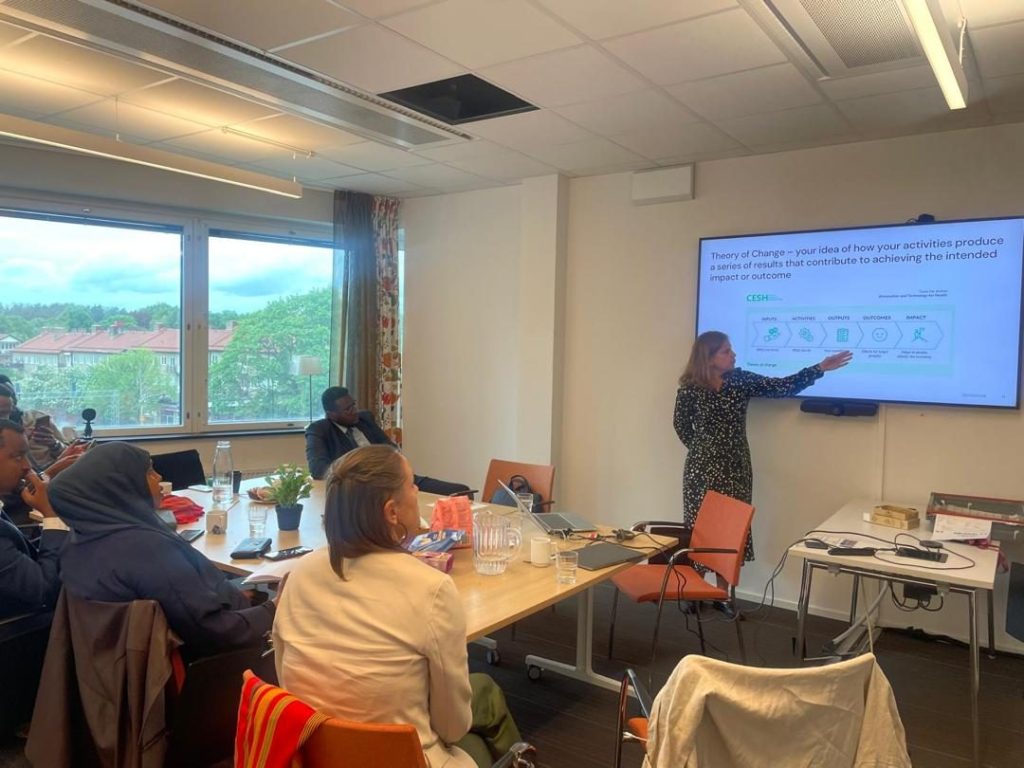
That cascading approach is already working in practice.
Want the detail behind a work package?
Get in touch for programme documentation, curriculum materials or partnership enquiries.